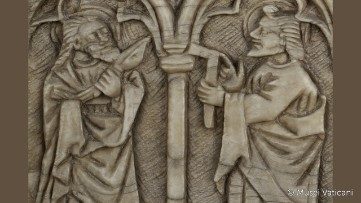
St. Jude Thaddeus and St. Simon, two of the least known
Apostles, are paradoxically among the closest to their Master, two of
his cousins. At least, the tradition is quite certain of it as regards
Jude Thaddeus, since it is clear from the Scriptures that his father,
Alpheus, was the brother of St. Joseph, while his mother, Mary Cleophas,
was a cousin of the Virgin. As for Simon, things are shrouded in fog.
Many faces, an Apostle
The Gospel names St. Simon as the tenth apostle, just before Jude
Thaddeus. Many identify in Simon the homonymous cousin of Christ,
brother of James the Younger. The Byzantines identify in him Nathanael
of Cana and the canteen director at the wedding of Cana, while St.
Fortunatus of Poitiers states that Simon and Jude Thaddeus were buried
in Suanir, a city in Persia, where they suffered martyrdom. According to
tradition, it is almost certainly in this part of the world that Simon,
known as the Zealot or the Canaanite, as the evangelists Matthew and
Mark call him, crossed paths with Jude THaddeus, who would be his
companion in mission until the end.
Jude, the faithful disciple
When the Eleven dispersed from Jerusalem to proclaim the Kingdom of
God in other lands, Jude Thaddeus departed from Galilee and Samaria to
go into Syria, Armenia and ancient Persia. In this area, authoritative
sources claim, he met Simon, and their missionary partnership won tens
of thousands of Babylonians and people from other cities for Christ. As
always, the Gospel earned for itself both followers and enemies: for the
two Apostles, the hour of supreme witness eventually arrived.
The courage to be called Christians
Arrested and taken to the Temple of the Sun, the sentence imposed on
both was to worship the goddess Diana, and so to deny Christ. In
refusing, it is said that Jude Thaddeus declared pagan idols false, and
that at the same time two horrible demons came out of the temple,
destroying him. Frightened, the people watching the scene are said to
have pounced ferociously on the two Apostles, who are brutally killed.
Their relics are kept in the Basilica of Saint Peter.
* Sl 18: Com
poucas diferenças, este salmo é reproduzido em 2Sm 22. Trata-se de uma
celebração para agradecer a proteção de Javé, através da qual o rei Davi pôde
realizar sua função política.
*
2-25:
A função da autoridade política não é usurpar o lugar de Deus, usando o poder
para seus próprios interesses e privilégios. É tornar historicamente presente e
visível a ação de Deus, que liberta dos inimigos o seu povo, para fazê-lo viver
segundo a justiça e o direito. Quando a autoridade política de fato procura ser
mediadora na realização do projeto divino, ela pode invocar a Deus e estar
certa de que ele responderá, dando eficácia a ela em seus empreendimentos.
*
26-30:
A autoridade é íntegra quando reflete a própria integridade de Deus; esta
consiste em fazer justiça, salvando o povo pobre e rebaixando o opressor.
*
31-35:
Outra função da autoridade é eliminar a idolatria, para que o povo possa, de
fato, reconhecer o Deus vivo e o projeto dele.
*
36-43:
Se a autoridade serve realmente a Deus e ao povo, ela se torna invencível:
pode, ao mesmo tempo, contar com o apoio de Deus e com a credibilidade e apoio
popular.
*
44-51:
Quando a autoridade realiza a justiça em nome de Deus, o povo vive na
fraternidade e o rei justo se torna modelo de liderança para outros povos.
* Sl 140:
Súplica de um inocente injustamente perseguido.
*
2-6:
Junto com a súplica, descreve agudamente o comportamento e ação dos injustos
contra os justos.
*
7-12:
O título «meu Deus» caracteriza o Deus da Aliança, que acompanha e lidera as
lutas do seu povo. O salmista aplica esse título à sua situação pessoal.
*
13-14:
O pedido mostra que a finalidade da justiça é libertar o pobre e defender o
direito dos que nada têm. Aí está a grande proclamação do povo de Deus.




Nenhum comentário:
Postar um comentário